
Management Message


Management Policies and Business Strategy



Sustainability
At JBS, in order to pass down an abundant global environment and sustainable society to the next generation, we fulfil our duties as members of society and incorporate efforts to contribute to resolving environmental and social issues into our business activities. Additionally, in order to maintain transparency in our management while realizing medium- to long-term improvement in corporate value, we have formulated a basic policy on sustainability (ESG) and promote efforts based on various policies.

Risk Factors
Information on risks that may significantly affect the financial position and management.

Board of Management
The list of directors and their biographies is available here.
Member of the Board of Directors
The list of all officers, including executive officers, is available here.

Corporate Governance
Board of Directors
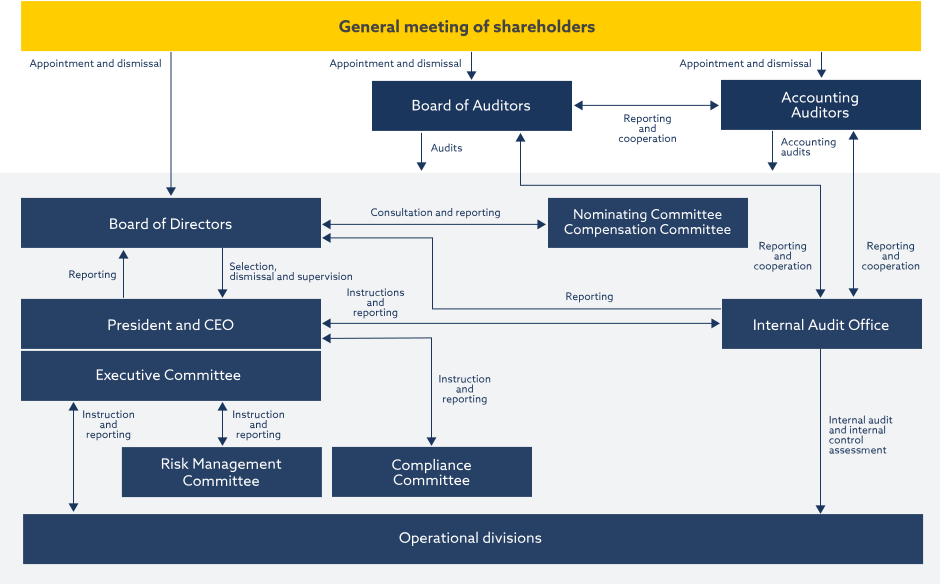
JBS’s Board of Directors consists of nine directors (including six outside directors and directors who are Audit and Supervisory Committee members), and the Representative Director and President serves as chairperson. In principle, the Board of Directors holds a regular meeting once a month and also convenes special meetings in a timely manner as necessary. The Board of Directors passes resolutions on matters required by law, determines important management matters, and supervises the execution of business.
Executive Committee
To ensure appropriate and agile decision-making on the execution of duties, JBS has established a Executive Committee composed of the Representative Director and President and directors who concurrently serve as employees, with the Representative Director and President serving as chairperson. The Executive Committee deliberates on overall management policies, management plans, and other important matters related to the execution of duties. Directors who are Audit and Supervisory Committee members and outside directors (excluding outside directors who are Audit and Supervisory Committee members) may attend and express their opinions.
Audit and Supervisory Committee
JBS is a company with an Audit and Supervisory Committee. The Audit and Supervisory Committee consists of three outside directors who are Audit and Supervisory Committee members (one full-time member and two part-time members), and the chairperson is appointed from among the committee members by resolution of the Audit and Supervisory Committee. The committee receives reports on and discusses the status of audits conducted by each member. In principle, the committee meets once a month and also holds extraordinary meetings as necessary. In addition, the committee members attend important meetings such as the Nomination Committee and the Compensation Committee and conduct on-site audits. To conduct audits efficiently, they also maintain close coordination and exchange opinions with the internal audit department and the independent auditor, as appropriate. Furthermore, in preparation for a situation in which the number of Audit and Supervisory Committee members required by law is not met, the Company has elected one substitute director who is an Audit and Supervisory Committee member as provided in Article 329, Paragraph 3 of the Companies Act.
The Nomination Committee and Compensation Committee serves as an advisory body to the Board of Directors. It consists of seven directors, including six outside directors, and the Representative Director and President serves as chairperson. The committee meets at least once in each fiscal year. From an objective and fair perspective, the Nomination Committee deliberates on matters related to the appointment of directors, executive officers, and other officers, while the Compensation Committee deliberates on matters related to officer compensation.
Risk Management Committee and Compliance Committee
JBS has established a Risk Management Committee chaired by the head of the department responsible for risk management and a Compliance Committee chaired by the executive officer responsible for legal affairs and compliance, and strives to minimize the impact of crises and ensure thorough compliance.
Internal Audit
At JBS, the Internal Audit Office (seven members), which reports directly to the Representative Director and President and is independent from each department, conducts internal audits based on the internal audit plan in order to evaluate the effectiveness of internal controls and the appropriateness of actual business operations. Audit results are reported to the Representative Director and President, the Board of Directors, and the Audit and Supervisory Committee. The audited departments receive feedback on the results and findings, and the Company requests and confirms responses from the heads of those departments regarding corrective measures and policies.
Accounting Auditors
The Company has entered into an audit agreement with Ernst & Young ShinNihon LLC, which audits the Company’s financial statements. There are no special interests between the audit firm and the Company.
Policies and Procedures for the Nomination and Removal of Senior Management and Directors
Policy for the Nomination and Removal of Directors
The Company selects director candidates who satisfy the following requirements:
- Meet the legal requirements prescribed by the Companies Act
- Are not recognized as having any relationship with anti-social forces
- Have excellent character and insight and are capable of fully discharging their duties as supervisors of management (or, in the case of directors who are Audit and Supervisory Committee members, as auditors)
Policy for the Nomination and Removal of Outside Directors
In addition to satisfying the policy for the nomination and removal of directors, candidates shall have a track record of playing a leadership role in fields such as management, law, accounting, public administration, consulting, or education, and shall possess professional expertise.
Criteria for Determining Independence and Qualifications of Independent Outside Directors
JBS designates independent outside directors in light of the Tokyo Stock Exchange’s “Criteria for Assessing the Independence of Independent Directors/Auditors” and other relevant standards. In determining independence, a “major business partner” means a business partner for which the amount of transactions with the Company in the immediately preceding fiscal year accounts for 2% or more of the sales of either the Company or the business partner.
When designating candidates for independent outside directors, the Company endeavors to nominate individuals who have a sufficient understanding of the Company’s business and possess the experience, capabilities, and qualities necessary to provide rigorous supervision and advice from an objective, third-party perspective, and who can contribute to frank, active, and constructive discussions at Board of Directors meetings.
Procedures for the Appointment and Dismissal of Directors
The Board of Directors selects candidates, and their appointment or dismissal is resolved at the General Meeting of Shareholders. Candidates for directors who are Audit and Supervisory Committee members require the prior consent of the Audit and Supervisory Committee.
Disclosure Policy
Approach to Disclosure
Article 1 Basic Policy on Information Disclosure
- Japan Business Systems, Inc. ("the Company") shall actively and promptly disclose information to shareholders, investors, and all other stakeholders on the basis of transparency, fairness, and continuity.
- The Company shall disclose important information that can affect investment decisions by investors in accordance with the Financial Instruments and Exchange Act, the Securities Listing Regulations, etc. (Exchange Rules) stipulated by the Tokyo Stock Exchange (TSE), and the Corporate Governance Policy, etc.
Article 2 Method of Information Disclosure
- Information subject to the Timely Disclosure Rules stipulated by the TSE shall be disclosed through the TSE's Timely Disclosure Network (TDnet).
- In addition, information disclosed via TDnet shall also be promptly posted on the Company's website.
- In addition, for cases of disclosing information that is not subject to the Timely Disclosure Rules, the Company shall endeavor to disclose such information through the Company's website.
- The Company shall disclose annual securities reports, etc. based on the Financial Instruments and Exchange Act on the Electronic Disclosure for Investors' NETwork (EDINET) provided by the Financial Services Agency.
Article 3 Earnings Forecasts and Other Forward-Looking Information
- The Company's earnings forecasts, strategies, plans, etc. disclosed by the Company, with the exception of those relating to past or present facts, are forward-looking outlooks based on judgments and certain assumptions made in light of the information currently available to the Company. They are inherently subject to various factors such as changes in economic conditions, the business environment, and uncertain variables that may cause actual results to differ from such outlooks.
Article 4 Prevention of Insider Trading
- The Company shall establish internal rules to prevent insider trading and promote awareness and understanding of such rules among all officers and employees.
- The Company shall work to prevent insider trading by properly managing information on material facts that can influence investment decisions and promptly disclosing such information in accordance with various laws and regulations and the Timely Disclosure Rules.
Article 5 Quiet Period
- In order to ensure the transparency and fairness of information disclosure and to prevent the leakage of information on unannounced financial results, the Company shall set a quiet period from the day following the end of the fiscal term to the day of the announcement of financial results.
- During this period, the Company shall refrain from answering questions or commenting on financial results and earnings forecasts.
- However, even during the quiet period, the Company shall endeavor to respond to questions and the like regarding information that has already been announced, information that has been publicly disclosed or become public knowledge, and information disclosed via TDnet during the quiet period.
Overview of the Timely Disclosure System
Basic Policy
At JBS, based on the Company's Timely Disclosure Rules, we regard the timely and appropriate disclosure of JBS Group corporate information to shareholders, investors, and other stakeholders as an important responsibility. In addition to timely disclosure required under the Financial Instruments and Exchange Act and other laws and regulations and the rules stipulated by stock exchanges, we will also endeavor to disclose, as promptly and clearly as possible, information that is not required to be disclosed under the timely disclosure system when we judge that such information will contribute to promoting stakeholders' understanding.
Education
JBS strives to ensure that officers and employees (including officers and employees of subsidiaries) are fully informed of material facts subject to timely disclosure by taking opportunities at important meetings, training sessions, and similar occasions.
Determined Facts
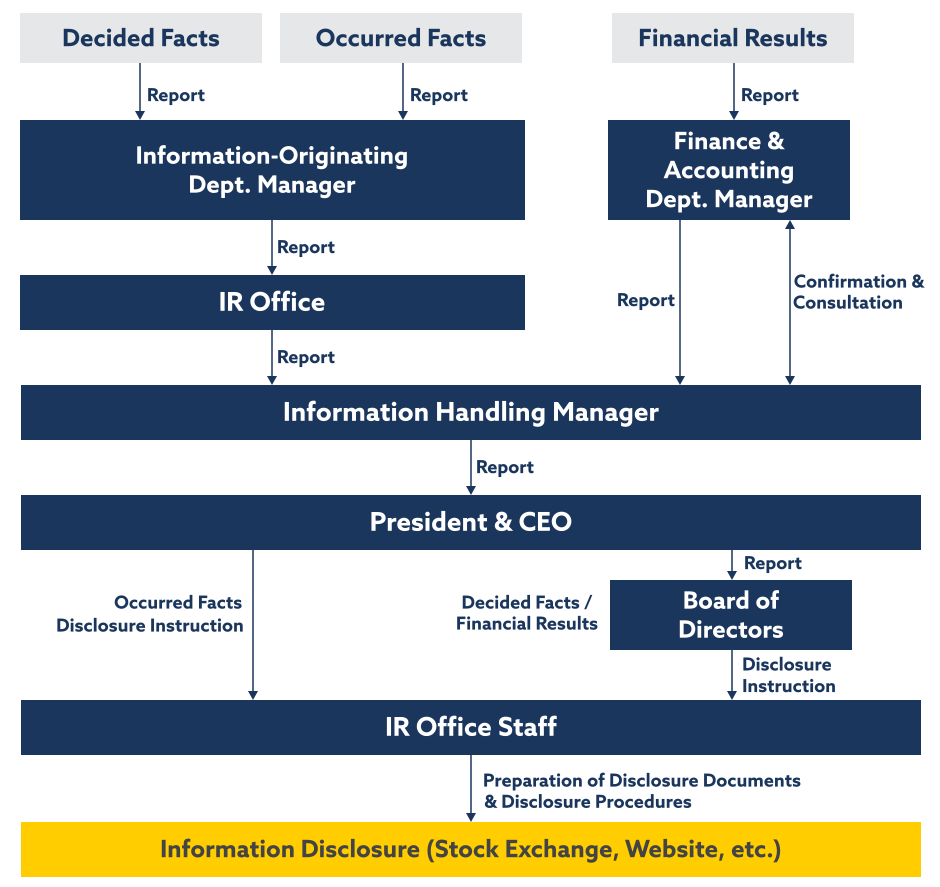
The IR Office obtains in advance the agenda items for important meetings such as meetings of the Board of Directors and the Executive Committee, and promptly obtains the minutes after such meetings. It then reviews whether there are any material facts (material information) subject to timely disclosure, and if so, immediately reports them to the officer responsible for information handling (the executive officer in charge of the IR function), prepares disclosure documents, and discloses them following a resolution of the Board of Directors.
Occurrences
When a relevant event occurs, the department that recognizes the occurrence contacts the IR Office. The IR Office examines whether the matter is subject to timely disclosure and, if so, reports it to the officer responsible for information handling. The IR Office then prepares the disclosure documents and discloses the information under the instruction of the Representative Director and President.
Financial Information
Led by the Finance and Accounting Department and in cooperation with the IR Office, the Company prepares financial disclosure documents (such as earnings reports and quarterly earnings reports) and discloses them after obtaining a resolution of the Board of Directors.
Timely Disclosure Procedures for the JBS Group
JBS has subsidiaries and receives their monthly financial statements by the end of the following month. In addition, the determination of important matters by subsidiaries requires JBS's approval. Based on this framework, the IR Office identifies and examines whether there are any material facts subject to timely disclosure, and if applicable, reports them to the officer responsible for information handling. Upon receiving such a report, the IR Office prepares the disclosure documents and, if the matter is not an agenda item for the Board of Directors, discloses it with the approval of the Representative Director and President; if it is an agenda item for the Board of Directors, disclosure is made after approval by the Board of Directors.
(Reference) Information Disclosure Process
Timely Disclosure
