Basic Concept and System
Status of Compliance with the Corporate Governance Code
JBS discloses its status of compliance with each principle of the Corporate Governance Code established by the Tokyo Stock Exchange. For details, please refer to our Corporate Governance Report.
- Please note that our Corporate Governance Report are available for use exclusively within Japan.
Basic Concept and System for Corporate Governance
With the awareness that corporate governance is essential in order to continuously improve corporate value, we are focusing on its strengthening and enhancement. We aim to establish good relationships with our shareholders and other stakeholders, and realize long-term growth by launching business activities that grasp the needs of society.
By resolution of the 35th Ordinary General Meeting of Shareholders held on December 18, 2025, the Company transitioned from a company with an Audit & Supervisory Board to a company with an Audit & Supervisory Committee. The purpose is to further enhance corporate governance by speeding up and streamlining management decision-making in order to achieve sustainable growth and improve medium- to long-term corporate value, and by strengthening the supervisory function of the Board of Directors through directors who are Audit & Supervisory Committee members holding voting rights at the Board of Directors.
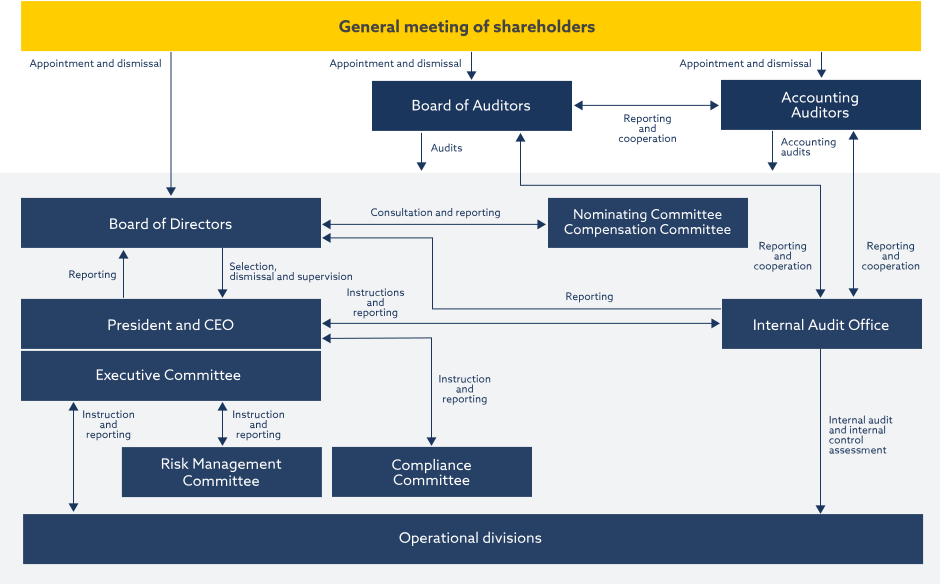
Corporate Governance Structure
In addition, by appointing outside directors who make up a majority of the total number of directors, JBS actively reflects appropriate advice and proposals from an external perspective in its management. Furthermore, by establishing a Nomination Committee and a Remuneration Committee, mainly composed of outside directors, under the Board of Directors, we ensure the appropriateness and transparency of the appointment and remuneration of directors.
Approach to Cross-Shareholdings
Policy on Cross-Shareholdings
From a medium- to long-term perspective, JBS may hold listed stocks as a policy for the purpose of collaboration based on business alliances and the like. When holding such stocks, each year the Board of Directors comprehensively considers the appropriateness of the purpose of holding and the benefits and risks associated with holding, and verifies whether or not the holding is appropriate. If there is rationality in holding—such that holding the issuing company’s stock enhances our corporate value and leads to the interests of our shareholders—we continue to hold it; otherwise, we consider reducing it through sale or other means.
Criteria for Exercising Voting Rights
In exercising voting rights pertaining to cross-shareholdings, JBS does so after confirming, in light of our purpose of holding, whether the proposal conforms to our holding policy and whether it contributes to the efficient and sound management of the issuing company and thereby to the improvement of the corporate value of the issuing company and, ultimately, of our company.
Verification of the Appropriateness of Holdings
Regarding the listed cross-held shares held by JBS, as a result of examining the appropriateness of the holdings at the Board of Directors based on the above policy, we have judged that there are no problems.
Board of Directors Agendas and Analysis / Evaluation of Effectiveness
Main Agendas of the Board of Directors
FY2025/9
| Category | Main Items Deliberated |
|---|---|
| Management / Business Strategy | Business policy, medium-term management targets, budget formulation, organizational structure, human resource strategy and personnel systems, investment and equity participation, group operations, sustainability, dialogue with stakeholders |
| Finance / Financial Results | Financial strategy, capital policy, annual and quarterly financial results, reporting of figures such as monthly performance and finances, securities reports, surplus and dividend policy, response to management conscious of the cost of capital and stock price |
| Governance / Risk / Compliance | Evaluation of the effectiveness of the Board of Directors, executive personnel, matters concerning officers, internal audit reports, status of risk management, compliance reports |
Evaluation of the Effectiveness of the Board of Directors
Analysis and Evaluation Method
To continuously improve the functioning of the Board of Directors and thereby contribute to the improvement of medium- to long-term corporate value, JBS conducts analysis and evaluation of the effectiveness of the Board of Directors.
Setting the evaluation period as FYE September 2025, we conducted a self-evaluation questionnaire on the following items targeting all directors and auditors. Based on the analysis and evaluation results regarding the aggregated responses, our Board of Directors conducts constructive discussions on developmental issues to be addressed in the future. To ensure fairness and objectivity, we used an external organization in designing the self-evaluation questionnaire and in its analysis and evaluation.
- Composition of the Board of Directors
- Operation of the Board of Directors
- Management strategy and responsibility to stakeholders
- Risk management, internal control, compliance, and crisis management systems, etc.
- Evaluation and remuneration of management
- Status of response to the previous year’s developmental issues
Overview of the Effectiveness Evaluation Results
At our Board of Directors, decisions are made through multifaceted and free and open discussion of management issues, and a system to supervise the execution of duties is sufficiently developed and functioning; therefore, we evaluate that the effectiveness of the Board of Directors is ensured.
Regarding the developmental issues recognized in the effectiveness evaluation for FYE September 2024, we have carried out the following initiatives and have generally improved them:
- Examination of responses to management conscious of the cost of capital and stock price, and disclosure of the status of such responses
Future Initiatives
Through the evaluation for FY2025/9, we recognized, as developmental issues toward further improving effectiveness, working on the advancement of sustainability-related governance and the strengthening of supervision over human-capital-management initiatives, among others. Based on this recognition, our Board of Directors will continuously consider and implement the measures necessary to further improve effectiveness.
Internal Control System
Basic Concept of the Internal Control System
JBS has formulated a Basic Policy for the Development of an Internal Control System, and in order to execute operations appropriately and efficiently, it clearly defines job authority and the division of duties through various internal rules, thereby developing a system in which appropriate internal control functions.
Internal Audit System
To audit the effectiveness of the compliance systems of the Company and its subsidiaries, JBS has established an Internal Audit Office under the direct control of the President & Representative Director. The Internal Audit Office establishes the “Internal Audit Rules” and conducts internal audits in accordance with these rules. The Internal Audit Office also builds cooperative relationships with the Audit & Supervisory Committee and the accounting auditors as necessary in an effort to conduct efficient internal audits. When a correction or improvement is pointed out by the Internal Audit Office or when deemed necessary, each responsible department and audited department promptly takes measures. In addition, the President & Representative Director, the Audit & Supervisory Committee, and the Internal Audit Office regularly exchange opinions. Our Internal Audit Office is composed of seven members and, based on the Internal Audit Rules, audits whether the business activities of the JBS Group as a whole are being conducted appropriately, including compliance with management policies, internal rules, and compliance requirements. By participating in the activities of the Risk Management Committee, the Information Security Committee, the Compliance Committee, and others, the Internal Audit Office formulates audit plans that reflect the Company’s risk information, and by reporting audit results to the President & Representative Director, the Board of Directors, and the Audit & Supervisory Committee, ensures the effectiveness of internal audits.
Internal Reporting Desk
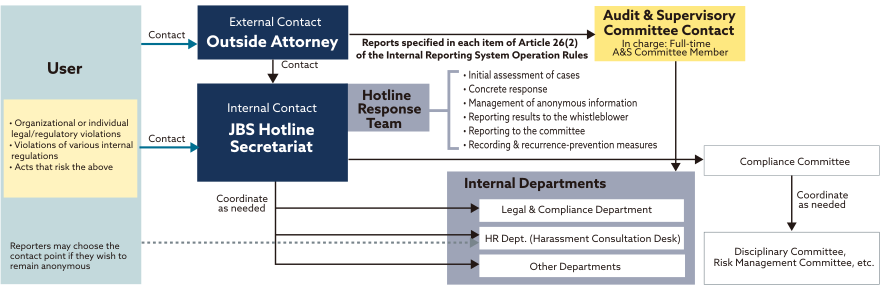
To ensure thorough compliance, JBS has established the “JBS Hotline” as an internal reporting system that accepts reports and consultations from officers and employees of the JBS Group, retirees, and their families. In addition to an internal desk, we have established an external desk staffed by an independent attorney who is not our corporate legal counsel, thereby ensuring independence from management. The scope of acceptance is broad, covering not only legal violations and violations of internal rules but also acts that harm the workplace environment, such as harassment. The number of reports under this system in fiscal 2025 was 17.
Risk Management
We established internal regulations related to risk management, and established the Risk Management Committee consisting of the person in charge of risk management departments as the committee head and committee members appointed from among directors from each department under a director in charge of risk management appointed by the President and CEO. The committee meets every month.
We prevent impairment of corporate activities through risk management, and in the event that a risk become apparent, we minimize its impact through crisis management. This overall is aimed at improving the JBS Group’s corporate value in a sustainable manner. Specifically, we formulate a yearly policy and plan on risk management and undertake activities to grasp, assess, monitor, and respond to risks.
1. Management Risks
| Risks | Type | Main Measures |
|---|---|---|
| Risks related to corporate strategy, subsidiary management, executives |
|
|
2. Financial Affairs / Business Risks
| Risks | Type | Main Measures |
|---|---|---|
| Risks related to accounting, finance, business management, etc. |
|
|
3. Operational Risks
| Risks | Type | Main Measures |
|---|---|---|
| Risks related to operations |
|
|
4. Service Provision Risks
| Risks | Type | Main Measures |
|---|---|---|
| Risks in profitability, quality, outsourcing, claims for damages, etc. accompanying the provision of services |
|
|
5. Security Risks
| Risks | Type | Main Measures |
|---|---|---|
| Information security risks |
|
|
6. Internal System Risks
| Risks | Type | Main Measures |
|---|---|---|
| Risks related to malfunctions of internal systems and their operation |
|
|
7. Human Resources Risks
| Risks | Type | Main Measures |
|---|---|---|
| Risks related to occupational health of employees (including pandemics), safety, scandals, human resources |
|
|
8. PR Risks
| Risks | Type | Main Measures |
|---|---|---|
| Risks related to PR, IR, reputation, etc. |
|
|
9.Disaster and Accident Risks
| Risks | Type | Main Measures |
|---|---|---|
| Risks accompanying natural disasters such as earthquakes or fire or occurrence of accidents |
|
|
Even when we are forced to suspend business activities due to disasters and other threats, we have developed a business continuity plan (BCP) to fulfill our social responsibilities by minimizing the impact on the businesses of our customers and other stakeholders, with which we have built a system to secure the safety of all employees and continue our business including providing services to our customers.
Internal Control System and Internal Audit System
As a group overall, we endeavor to maintain an internal control system, and in light of the Companies Act and Ordinance for Enforcement of the Companies Act, the Board of Directors has passed on the Regulations on a Basic Policy for an Internal Control System.
In order to audit the efficacy of the compliance system at JBS, we have established an Internal Audit Office under the direct control of the President. The Internal Audit Office sets the Rules for Internal Audits and conducts internal audits in accordance with the provisions thereof. It also establishes a cooperative relationship with the Audit & Supervisory Board Members and the accounting auditors as necessary in an effort to conduct efficient internal audits.
Additionally, four qualified internal auditors (QIA) belong to the Internal Audit Office, and two certified public accountants and one certified internal auditor belong to the Governance Office, which is an observer organization. Each responsible department and department undergoing inspection takes prompt measures when a correction or improvement guidance is issued from the Internal Audit Office or when it is deemed that such action is necessary.
The Internal Audit Office gives regular audit result reports to the President & CEO, Board of Directors, and Audit & Supervisory Board, and the President & CEO, Audit & Supervisory Board Members, and the Internal Audit Office hold regular exchange of opinions.
Compliance
Anti-Corruption and Response to Antisocial Forces
Basic Concept toward the Elimination of Antisocial Forces
Aware of its corporate social responsibility and public mission, in order to sever any and all relationships with antisocial forces, JBS has resolved at the Board of Directors a Declaration and Basic Policy for the Elimination of Antisocial Forces and discloses its contents.
Declaration and Basic Policy on Elimination of Antisocial Forces
Status of Development
As for our internal system, based on the Basic Policy, we have established rules concerning the elimination of antisocial forces, designated the Legal & Compliance Department as the department that oversees responses, and are developing arrangements so that we can respond in an organized manner with the executive in charge of the Legal & Compliance Department as the person responsible. In addition, we have designated the Deputy General Manager of the General Affairs Department as the person responsible for preventing unjust demands, and have developed a system to respond to contact by antisocial forces in cooperation with external specialist organizations including the police. For employees, we have established provisions concerning the elimination of antisocial forces in the work rules, and ensure thorough compliance in accordance with the rules concerning the elimination of antisocial forces.
Compliance Code of Conduct
The JBS Group has established the “Compliance Code of Conduct” as a code of conduct that all officers and employees must observe, and by building a compliance promotion system, strives to ensure that all officers and employees comply with laws, social norms, and internal rules, and act ethically as members of a corporation. By sharing and ensuring the intent of the “Corporate Philosophy” and the “Compliance Code of Conduct” at each company of the Group, we secure the improvement of corporate value as a group.
Examples of the Application of the Compliance Code of Conduct
Holding of the Corporate Ethics and Compliance Promotion Month
At JBS, we designate October 1 to October 31 each year as the “JBS Corporate Ethics and Compliance Promotion Month,” and carry out promotion activities aimed at improving corporate ethics and ensuring legal compliance for each company and division of the Group. As part of these activities, we conduct compliance training for all officers and employees, providing each officer and employee with an opportunity to be conscious of compliance and striving to firmly establish compliance awareness throughout the organization.
Quality Improvement
Our Approach to Quality
The JBS Group undertakes to “use all resources for our customers’ satisfaction” under the basic concept of our customer first principle. In order to be the best partner that provides the best systems and services to our customers, and continue to always provide customers with strategic and practical information systems, we endeavor to realize high-level IT services based on high technological capabilities and a rich track record, and at the same time, engage in quality improvement from all sides.
Acquisition of Accreditations
In order to realize safe and certain information management in the IT solution services we provide to customers, we have adopted and operate the following management systems.
Initiatives toward Quality Improvement
JBS conducts a bidirectional assessment questionnaire every year with its suppliers from an ESG viewpoint and strives to improve quality by feeding back the results in both directions.
- Conducted with distributors that are suppliers of hardware and software. Outsourcing contractors are not included.
Initiatives in Procurement
For procurement, we maintain good relationships with business partners with high skills while improving the sophistication and homogenization of service levels in order to pursue the “customer first” principle, which is part of JBS’s code of conduct.
In addition, when procuring devices such as PCs used within JBS, we give priority to dealing with manufacturers with which we can collaborate on environmental measures such as carbon offsetting. Through the PC manufacturers from which we procured, we invested in greenhouse gas reduction activities of 470 tons in FYE September 2024 and 295 tons in FYE September 2025.
Protection of Organizational Assets
JBS regards information assets as the foundation of corporate value and is strengthening security that supports a hybrid environment of cloud and on-premises. We have adopted a zero-trust model, advanced our authentication and access control, introduced AI-based threat detection and automated defense, and strengthened endpoint protection. To deepen our understanding of changing information security threats, we continue vulnerability diagnoses and targeted-attack email drills, maintain a BCP system, and regularly conduct restoration drills of our system environment. Through these initiatives, we maintain the trust of customers and business partners, support sustainable business operations, and safely support data utilization and business transformation as a foundation for promoting DX.
