Mid-term Management Targets
Shift to enhanced profitability centered on engineering services
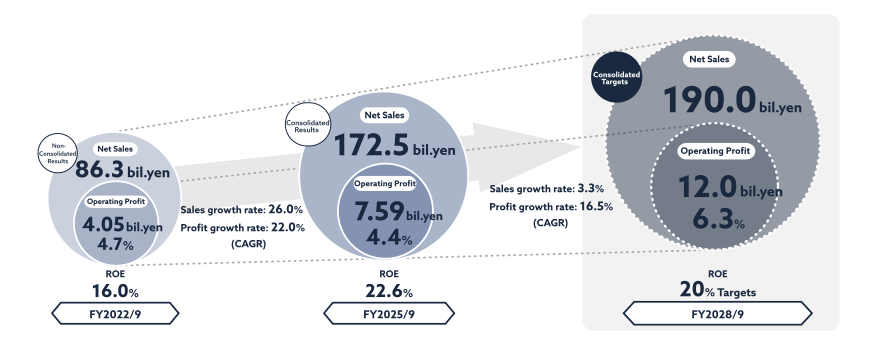
As its mid-term management strategy, JBS is advancing a shift to a profit growth model centered on engineering services. The domestic cloud market is expected to continue its strong growth, expanding primarily in the IaaS segment. In addition, as companies accelerate their DX investment, needs for multi-cloud, security, and generative AI are also expanding. Against this market backdrop, the JBS Group is deepening customer engagement and promoting Business Services, AI, and Global as strategic businesses, aiming to achieve net sales of 190.0 billion yen and operating profit of 12.0 billion yen in the fiscal year ending September 2028. In particular, for operating profit, we have set a growth target of maintaining a compound annual growth rate (CAGR) of 16.5%.
Business Environment
Cloud investment continues to grow. Meanwhile, complex challenges need to be addressed
While cloud investment among domestic enterprises continues to expand, cloud environments built through individual optimization have led to siloization, and many customers face challenges with increasingly complex operations. As a result, there is growing demand for multi-cloud support and integrated operations that optimize infrastructure, applications, and networks as a unified whole. Furthermore, as investment in generative AI accelerates, the need to apply AI to real-world operations is rapidly rising, amid challenges such as keeping pace with technology and aligning AI with existing environments. In addition, there is a shortage of personnel who can bridge IT and business—essential for advancing DX—and expectations for JBS to support customers’ in-house IT capabilities are higher than ever.
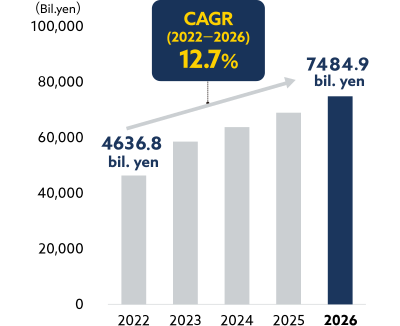
Ongoing investment in the domestic cloud
Double-digit growth continues due to demand for legacy system support and generative AI.
IaaS is showing high growth rates, particularly driven by core systems and security requirements.
Siloing of Cloud Environments
Cloud migration optimized on an individual basis has led to increasingly complex internal operations.
The integration and optimization of applications, infrastructure, and networks across multi-cloud environments is an upcoming challenge
AI Expectations and Confusion
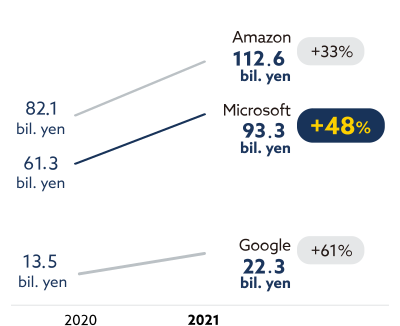
Investment in generative AI is accelerating. On the other hand, there are significant hurdles to practical implementation.
Keeping pace with rapidly advancing AI technologies and applying them to complex internal environments is a challenge
Opportunities and Responses for JBS
Strengthening three strategic businesses as drivers of future growth
In response to these demands, in addition to infrastructure modernization including multi-cloud support and enhanced security, we are promoting the expansion of Business Services, AI, and Global as strategic businesses that contribute to solving our customers’ medium-term management challenges. Furthermore, in 2022 we made Nextscape—a company with strengths in video streaming and application development—a subsidiary, and in 2025 we made AIexe, which excels in AI-driven service development, a subsidiary. In August 2025, we established SureBizCloud, a specialist company in cloud ERP and CRM, steadily strengthening our business foundation and operational structure.
Business portfolio transformation
The JBS Group has built a solid business foundation by expanding transactions with enterprise customers, starting from the provision of Microsoft Cloud licenses. As a result, “License & Products,” which involves the resale of licenses and PCs, has driven sales growth. Going forward, to further expand business with the customers we have cultivated to date, we will raise the ratio of “Engineering Services” centered on cloud integration and cloud services, thereby improving company-wide profitability. The JBS Group is transforming its business portfolio from a resale-centered model to one that delivers high value-added services, strengthening Business Services, AI, and Global as strategic businesses. In addition, we are advancing the sophistication of security, multi-cloud, and managed services, for which needs are growing as customer enterprises further utilize the cloud. Through these efforts, we will shift the composition ratio of “License & Products” to “Engineering Services” from the current 7:3 to 6:4 in the fiscal year ending September 2028, transforming into a portfolio with higher growth potential while continuing to meet our customers’ expectations.