Optimal Foundation for Modernization
Hybrid Cloud
We realize an optimal platform for companies by leveraging the strengths of both on-premises and public cloud environments in a hybrid cloud to enhance security, compliance, and differentiation.
Cloud Infrastructure for the AI Era
In today’s world where AI support is commonplace across all aspects of business, companies are required to address security and compliance more rigorously than ever before. At the same time, the volume of data to be processed continues to grow exponentially, demanding advanced processing capabilities. In such an environment, relying solely on on-premises or public cloud infrastructure can be limiting. For companies seeking to modernize towards an optimal platform, considering a hybrid cloud approach is essential.
Benefits of a Hybrid Cloud
Costs
In an on-premises environment, initial costs for hardware and software are required, but ongoing operational costs are relatively low. On the other hand, public cloud environments offer lower initial costs. However, ongoing costs can become significant.
Speed
For example, AI system processing requires high-performance computing resources such as CPUs and GPUs. In an on-premises environment, these resources must be procured and operated in-house, which requires significant time and effort for the initial build and subsequent maintenance. In contrast, public cloud environments allow you to use the required resources only when needed and for the necessary duration, enabling much faster deployment.
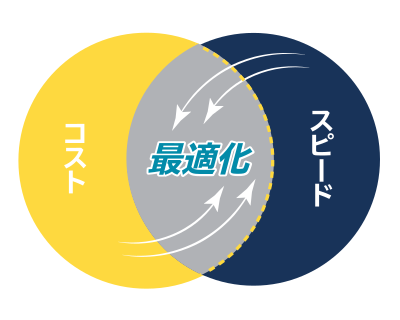
An Optimal Platform
Specifically, the following configuration can be considered:
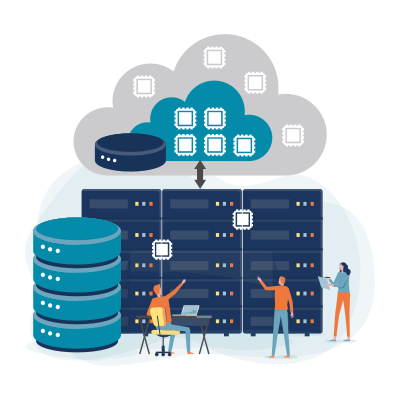
- Deploy data stores such as databases and storage in the on-premises environment.
- Prepare GPU resources in the public cloud for AI model training and inference.
With this configuration, the cost of data storage can be kept low, while improving the scalability and flexibility of processing. Of course, the specific configuration will vary depending on your system requirements and operational conditions. For example, in the following cases, it may be worth considering processing in the on-premises environment as well.
- Systems that handle highly confidential data
- Systems that require real-time processing
- Systems that require proprietary or custom processing and functionality
By combining data storage and processing locations, you can optimize both performance and costs.
Hybrid Cloud Characteristics
- Gradual Migration to the Cloud
-
With a hybrid cloud, it is possible to migrate to the cloud in stages by combining on-premises and public cloud environments.
For example, you can start by moving test and development environments, which were previously run on-premises, to the public cloud. This approach helps reduce costs and operational burden while allowing you to gradually understand cloud characteristics. By progressing step by step, you can complete the migration while minimizing risk.
With support from JBS, with our extensive expertise in CAF, you can achieve an efficient and high-quality migration.

- Security and Compliance Tailored to Your Business
-
For example, systems that handle customer or confidential information can implement strict security measures in on-premises environments. For operations where employees need broad access from any location, unified access control is essential.
Measures such as data encryption and access controls can be coordinated across both on-premises and public cloud environments to enhance data security.
Cloud Premium Services provide comprehensive operational and management support to ensure the latest security and compliance standards. For integrated ID management from on-premises systems to Microsoft Azure using Active Directory, leave it to JBS.

- Optimizing Construction and Operational Management Costs
-
For example, in an on-premises environment, hardware and software must be procured and operated in-house, resulting in both initial and ongoing running costs. On the other hand, the public cloud allows you to use only the resources you need for the required period, reducing initial costs, though running costs may increase.
By carefully evaluating what the optimal platform for your organization is through various assessments and workshops, cost optimization can be achieved across both implementation and operational phases.

Reasons to Choose JBS
- Certified Solution Partner
Multiple Specializations Achieved -
JBS is a certified Microsoft Solution Partner, and has also earned multiple specializations that demonstrate advanced technical capabilities. In addition, JBS has been recognized as the Microsoft Japan Partner of the Year for 12 consecutive years, an award also hosted by Microsoft Japan.

- Extensive Implementation Experience
-
JBS has implemented over 200 Azure projects annually across a wide range of industries, giving us deep knowledge in the unique considerations relating to cloud environments. Based on this experience and knowledge, we carefully select and propose the solutions that are best suited to each customer.

- Specialists Support Everything from Implementation to Operations
-
At JBS, over 1,000 engineers hold Azure certification. Using the Cloud Adoption Framework and Well-Architected Framework as the basis for cloud infrastructure design, we provide through-going support from cloud implementation to operations. This enables customers to promote cloud usage in a controlled and secure manner.

- Related Tag
 Share
Share