Turning the capabilities honed at each frontline into organizational strength
The vision of engineer growth that JBS envisions
For JBS, a company that continues to grow, the growth of each individual employee is an essential theme in enhancing corporate value.
Through the experiences of our engineers, who delve deeply into the operations of customers across diverse industries and provide solutions, the participants discussed the kind of engineer growth that JBS aspires to.
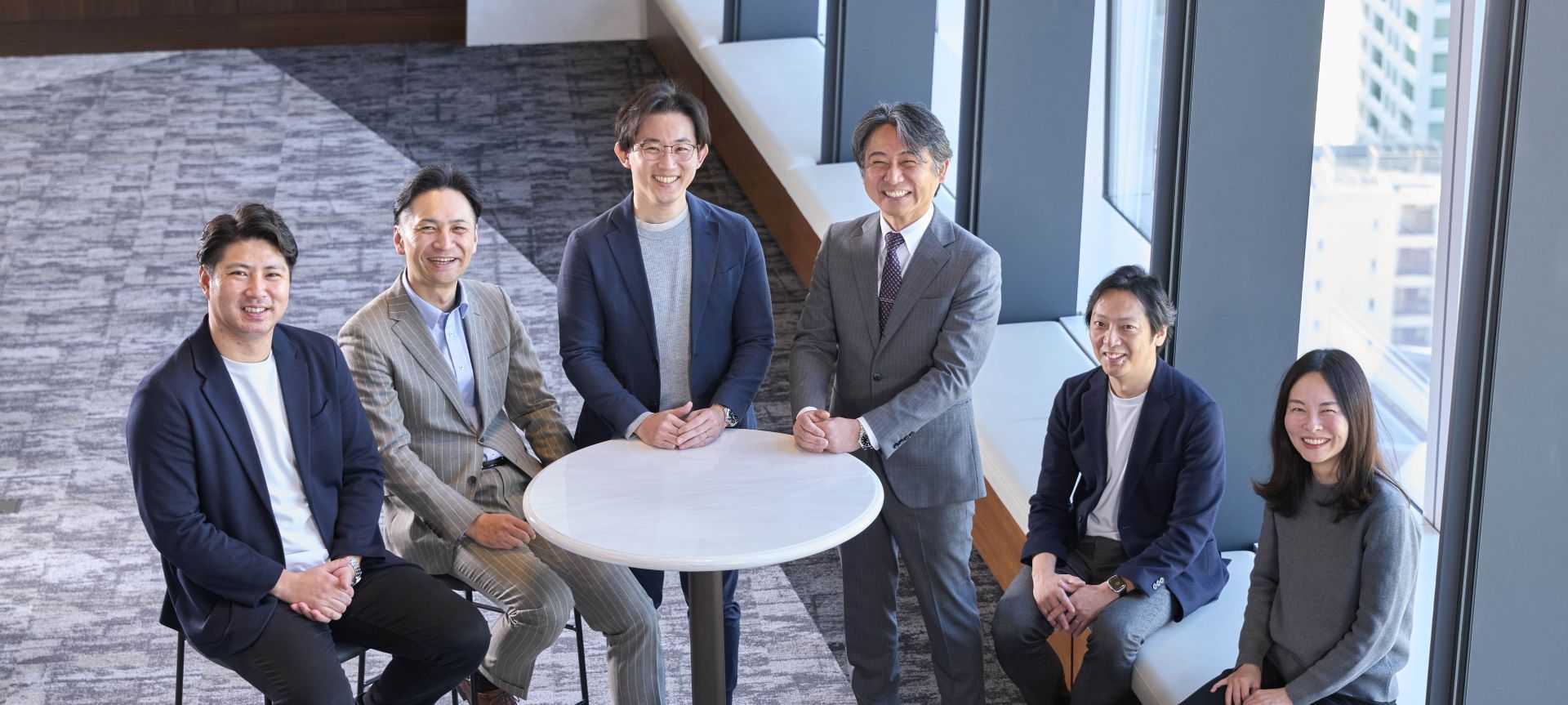
Roundtable Participants
-
Hirokazu Yasuda
Managing Executive Officer

-
Hidetomo Kanayama
Telecom & Services Div.

-
Sotaro Nagai
Financial & Insurance Div.

-
Nana Inose
Cloud Global Services Div.
Global Delivery Center

-
Hikaru Taguchi
Business Administration Div.
Delivery Promotion Dept.

-
Jun Munemoto
Cloud Managed Services Div.
Service Innovation Office

The Perspective Needed to Become a “Sought-After Engineer”

Yasuda
I joined JBS as an engineer in the second class of new-graduate hires.
Not long after joining, I casually asked the president what I should aim for going forward, and his reply was a single sentence: “Become an engineer whom customers request by name.” Those words left a strong impression on me, and ever since I have approached my work while asking myself what it truly means to be a sought-after engineer.
Through experiencing a variety of frontlines, I came to believe that, in the end, the measure is how much you can contribute to the customer. Becoming a dependable presence—someone of whom people think, “If I consult that person, the problem will be solved and given shape”—is what leads to being requested by name, as in “I want to work with that person again.” To achieve this, you need to develop not only your skills as an engineer but also a diverse range of skills that move the project and, ultimately, the customer’s heart. From my own experience, I believe that the accumulation of individual growth is precisely what raises the value we provide to customers and serves as the driving force behind JBS’s growth. That is why I want to ultimately enhance JBS’s value by supporting each employee so that they can grow autonomously and advance toward the ideal vision of who they want to become, and by providing an environment in which they can build experience.
The Diverse Frontlines JBS Engineers Take On, and the Skills They Require
Yasuda
To begin, I’d like each of you to speak freely about “the skills required on the frontline” from the perspective of your own department and role.

Nagai
I belong to a division responsible for the development and operation of systems for financial institutions and insurance companies.
We have many opportunities to engage in dialogue with customers, and when we encouraged young employees to take on challenges proactively, I saw many of them develop not only their technical skills but a wide range of abilities and earn trust. Some engineers grow so remarkably that I am astonished—“Can someone really grow this much in a single year?” Seeing this, I truly feel the truth of what Yasuda said: that growth raises value. As engineers broaden their range as people in addition to their technical ability, their value as engineers increases dramatically. I feel privileged to witness that firsthand on the frontline.

Munemoto
The division I belong to is centered on development, and because there is relatively little input from customers, engineers are required to be able to dig into the market and customer needs themselves and design accordingly. On this point, I feel that the rise of AI brings both appeal and challenges to system development. In particular, it has become possible to carry out design and development using AI without being greatly influenced by an engineer’s development skills. As a result, I have a sense of crisis that it is becoming harder to cultivate the ability to properly evaluate a system’s usefulness, the validity of a design, and its weaknesses. Precisely in the coming era when AI becomes the norm, I feel that the human design and evaluation skills used to make judgments will become even more important.
Yasuda
Evaluation skills are of course important. Beyond that, when a problem occurs, you cannot identify the cause unless you understand its substance. Not only for the cloud but also for on-premises*1, the ability to grasp the overall structure and processes of a customer’s entire system environment will remain indispensable.

Kanayama
I agree. Precisely because the technological environment is changing dramatically—from on-premises to the cloud, and now with the emergence of AI—I think the importance of returning to the basics and understanding everything from the mechanisms to the processes is increasing.

Taguchi
When you understand the structure, you can also respond when using a different technology or applying it to another customer. There are people who can skillfully apply their experience and those who cannot, and whether you can organize your thinking as “the structure is the same, so I can think about it the same way” is quite important. From this perspective as well, I believe that understanding the process is indispensable.
Nagai
In reality, many cases are configured as hybrid environments that combine not only cloud environments but also on-premises, so the truth is that knowledge of the cloud alone is not enough to fully support customers. That is why I feel we need initiatives that intentionally give young employees opportunities to design on-premises systems from the ground up, in order to close the experience gap.
- 1 On-premises: Owning, managing, and operating servers, network equipment, software, and the like in-house.



Engineers Growing Autonomously: JBS’s Philosophy and Organizational Characteristics

Inose
I feel that JBS values an attitude of deeply understanding the customer’s frontline. I was with the Manufacturing Business Division until September 2025, and there we placed importance on opportunities to visit and actually see customers’ manufacturing sites; initiatives such as young employees visiting customers’ factories to experience the manufacturing floor firsthand and actively participating in manufacturing-related events happen naturally.
Yasuda
As Inose pointed out, unless we understand for what purpose and how customers run their business, we end up merely providing tools exactly as instructed. We are required, as IT professionals, to fundamentally discern what the truly useful optimal solution is for what the customer wants to achieve.
Inose
There are indeed many occasions when customers praise us, saying, “You understand our business well.” I believe we need the skill to provide solutions only after understanding the work in depth, down to its background and business structure.
Nagai
As an initiative of the Financial and Insurance Business Division, our sales representatives obtain financial qualifications and work to deepen their understanding of customers’ operations. Going forward, drawing on the activities of the Manufacturing Business Division, we would like to prepare to provide optimal support tailored to each business type and customer need—such as automating slip processing—by visiting the sites and branches where clerical work is carried out.
Actively Leveraging OJT (On-the-Job Training) to Get People onto the Frontline as Early as Possible
Yasuda
One of JBS’s characteristics is the stance of having people experience the frontline as early as possible. How do all of you, who are actually out on the frontline, feel about this?
Inose
When I talk with young employees, I often hear them say, “I want to produce results quickly and advance my career.” It is also true that when training continues for a long time, some people start to wonder, “Am I really being useful?” In terms of a sense of fulfillment as well, I think there is great significance in being able to experience the frontline at an early stage.
Taguchi
I too think that getting accustomed to the frontline early is very important, as it yields a great deal of learning. That said, regarding how much to teach in training and how senior employees should support juniors through OJT, while making it a basic principle that supervisors and seniors provide solid follow-up, I feel we can turn this into an even greater strength by continuing to refine it.
Yasuda
Of course, the prerequisite is that the customer accepts them. In that respect, having built relationships of trust strong enough to assign young employees is, I believe, one of JBS’s strengths. By experiencing firsthand on the frontline how senior engineers conduct themselves and how they draw out and enhance the customer’s corporate value, there should be a great deal to learn.
Nagai
That’s right. On the frontline, even young employees are recognized if they have properly prepared what they need to do, and they are corrected if they fall short. The fact that you can directly receive that kind of tension and stimulation is also one of the benefits of frontline experience.
Munemoto
When you hear “OJT,” you get the impression that every company does it, but the fact that you can experience the frontline from an early stage after joining can be called one of JBS’s distinctive features. When I ask students about their motivations in interviews, many say it is “because even young people have the chance to play an active role,” and I feel that our environment for gaining experience early is recognized outside the company as well.



The Evolution of Technology and the Search for Talent Development Suited to Diverse Individuality
Yasuda
Looking at directions for growth, front-line engineers who face customers are required to become full-stack*2 so that they can respond to a broad range of customer needs. On the other hand, there is also a path of growing as an expert specialized in a particular area, such as AI. At JBS, these two types of engineers have faced customers as a team, leveraging each other’s strengths. On the actual frontline, what points do you emphasize when thinking about your members’ growth?
Munemoto
From a frontline perspective, it would be ideal if everyone were a high-level full-stack engineer, but the difficulty and cost of each engineer maintaining that state are extremely high, so I believe that both full-stack engineers who can broadly cover multiple technical domains and experts deeply versed in a specific domain are equally important.
Yasuda
Given the increase in complex technologies and the growing diversification of customer requests, I think the current reality is that it is becoming difficult to meet customer expectations with full-stack engineers alone, without forming teams together with experts who possess specialized knowledge.
Munemoto
In honing engineers’ expertise, I place importance on having them take initiative. Since I believe initiative is not something you can teach through systems but is closer to organizational culture, it is important to draw out, through daily communication, their own interest and motivation to learn.
Inose
That’s impressive. I strongly agree that initiative is important. An attitude of proactively taking things on, rather than being passive, is indispensable. I myself continuously hold one-on-one meetings in which I have members describe, in their own words, the person they want to be in a few years or in ten years. By sharing their future career plans, their motivation for work increases and the direction of their growth becomes clearer.
Yasuda
If you merely handle work passively, it is hard to build up experience. It is important to have management that gets members to think about what they themselves “want to try” and draws out their initiative.
Nagai
Some young employees do not have an opinion about who they want to become. For example, with a question like “Who do you admire?” they can relatively easily come up with an answer. Wouldn’t an approach that draws on such role models also be effective?
Taguchi
Indeed, simply saying “I want you to show initiative” does not work. First, you must instill in the organization the premise that those who take on challenges and produce results are recognized. On top of that, we work to create an atmosphere that encourages people to take on challenges easily. To draw out initiative, I think it is also important to fairly evaluate and praise proactive remarks and actions.
Yasuda
As not only working styles but also career plans diversify, the methods for promoting members’ growth are becoming more complex as well. This is no longer an era in which it is enough to present the same learning to everyone, as in the past. To develop people by leveraging each individual’s personality, the ways of guiding them vary enormously. I feel that flexibility is being demanded of management as well.
- 2 Full-stack: Possessing broad knowledge and skills across multiple technical domains and being able to respond from a holistic, cross-cutting perspective.
Consolidating the Development Know-How Gained at Each Frontline and Sharing It Across the Entire Organization
Kanayama
Engineers’ skills can be developed most significantly through frontline experience, so the OJT mentioned earlier is important. In addition, I feel we need to organize and refine into know-how not only the good initiatives that arise on the actual frontline but also lessons such as “what I learned couldn’t be applied on the frontline” or “different knowledge was needed on the frontline.”
Taguchi
I think Kanayama’s point is extremely important. The know-how generated at each frontline needs to be turned into a shared asset for the entire company, rather than being confined to one’s own team or organization. I myself have been involved on the frontline as an engineer ever since joining, but over the past year I have been working to build a mechanism that collects the lessons obtained from scattered successes and failures and shares them across organizational boundaries. For example, as measures to connect lessons learned from failures to improvements, we revise training content and reflect them in pre-project checks. We are currently still exploring how to form a cycle of frontline experience, feedback, and systematization, but through that accumulation I want to turn individual experience into a strength for JBS as a whole.
Kanayama
I find it very reassuring that Taguchi, after accumulating frontline experience as an engineer, is now in a division that advances cross-organizational know-how sharing. Precisely because he knows firsthand how engineers grow on the frontline, his words carry persuasive power. With these feedback and sharing mechanisms being put in place, I feel the environment has become one in which the frontline can take on skill development more boldly, and I have very high expectations for the future.
Inose
Even across different departments, there are many common skills, such as the ability to manage projects and the ability to draw out needs through dialogue with customers. There is great significance in sharing these skills across organizational boundaries.
Yasuda
There was once an era when “Know Who” was more of an engineer’s strength than “Know How.” Today, however, rather than depending on a specific individual, we are required to raise the level of all engineers through sharing. To that end, I would like to place great expectations on the initiative Taguchi is taking on.
The Commitment of Professionals Active on Diverse “Frontlines”
Inose
The Cloud Global Services Business Division to which I belong is a newly established organization. What value will we provide to customers? We are at the stage of building the mechanisms for that and establishing ourselves as an organization. I feel both fulfillment and responsibility in being involved from the very timing of its launch. Until now, JBS may not have had much of an image of operating its business globally. In reality, however, we have supported many customers with local system construction and operation when they expanded overseas. Through our efforts in my current division, I would like to spread the recognition, both inside and outside the company, that JBS is a company that delivers value globally.
Munemoto
The Cloud Managed Services Business Division promotes the cloud services business as one part of the engineering services that JBS positions as a growth axis. While further extending the strengths we have cultivated to date, we want to grow the entire business by undertaking initiatives that create new growth drivers. The cloud services business is a high-expectation business that can cover a very wide range of solutions, but limited to the area the Cloud Managed Services Business Division currently handles, its revenue scale cannot yet be called large. In order to make it a business with a significant presence in JBS’s profit growth, I want to drive expansion of scale by transforming from a model centered on man-hours (labor) into services that provide tangible products and value-added experiences.
Kanayama
I belong to the Telecommunications and Services Business Division, where engineers and sales work as one. From that position, I regard advancing initiatives to enhance the sales capabilities of each individual engineer as a major role. If all of JBS’s more than 2,000 engineers come to have an awareness of expanding business opportunities, it should lead to significant growth. I want to once again share the strengths of engineers, who are in the position closest to customers and in touch with their concerns and needs, and embed this throughout all of JBS.
Taguchi
My role, as I mentioned earlier, is to elevate what each individual on the frontline has learned through experience into a form that can be utilized across all of JBS. In building that mechanism, I will proceed by aiming for a high-resolution form that, when completed and shared, does not disappoint the frontline but rather makes them think, “Well done.”
Nagai
I feel that the financial and insurance industries, which are the main customers of the division I belong to, still have great room for growth. To grow that field going forward, the presence of “engineers with sales capabilities,” as Kanayama said earlier, is indispensable. I will focus on raising the sales capabilities of the entire organization—not only frontline engineers but also through collaboration with other divisions.
Yasuda
In recent years, JBS has grown rapidly. At the same time, the honest truth is that there is still a great deal we should do, such as mechanisms for sharing know-how across the organization. As I said at the outset, the driving force behind JBS’s growth is, after all, its people. There is no doubt that how we broaden and develop individual capabilities is the key to business growth. Whether we can think flexibly, build mechanisms, and execute them amid the diversification of working environments and growth opportunities is a major proposition for management. I would like to connect the insights gained from this roundtable to a variety of initiatives.